How big are the signals at your antenna?
In order to determine the actual signal strengths that were present on my 144MHz EME antenna under worst case conditions, beaming straight at the main pager transmit site, I used my Icom PCR-1000 as a Spectrum Analyser . The software used was TalkPCR. I checked the calibration of the Spectrum Analyser with a signal generator and an RF millivoltmeter and it is appears to be accurate to couple of dBm.
The spectrum from 88MHz to 160MHz is displayed with amplitude in dBm. Resolution Bandwidth is 50KHz and mode NBFM. The vertical antenna elements are used since the majority of potential interfering stations are vertically polarised.
I did also scan right up through the UHF TV channels but have not saved the screens. The signal strengths were comparable to the Band 2 FM signals shown.
The first scan is direct from the antenna feedline without any preamplifier or filter: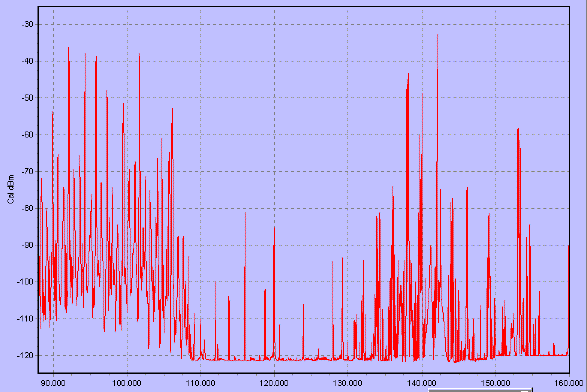
Note the huge signals from Pagers around 138MHz and 153 MHz. Also the carrier at 142MHz. Band 2 FM broadcast 88 to 108MHz signals are so strong you can see the Icom PCR-1000 producing a whole lot of Intermodulation products which raise the noisefloor of the RX.
The next scan is with a Mutek GFBA 144e preamplifier.
The Mutek gfba 144e has a NF of 0.9dB with a gain of 15dB with a 1dB passband of 6MHz and a 20dB passband of 15MHz (that is a loss of 5dB at 7.5MHz from 145 MHz). It consists of a GaAsFET first stage with noiseless feedback followed by a second stage highly linear bipolar transistor using negative feedback to provide a well defined termination for the first stage. A fixed attenuator follows the second stage then a 3 pole bandpass filter. I bought this in 1983 and it still works - though NF is high by modern standards. Certainly makes a good tropo preamp where anything less than 1.5dB NF will do.
The Third Order Input Intercept point IP3 of the Mutek preamp is specified as +14dBm.
Spurious Free Dynamic Range = (IP3 - Noisefloor) x 2/3
Noisefloor in an SSB bandwidth of 2.5KHz will be around -142dBm with typical 196 degrees Kelvin RX Noise temperature.
This means that the preamp will have a spurious free dynamic range of 104dB. Therefore maximum signal strength that preamp can handle before Intermod products are detectable will be -38dBm
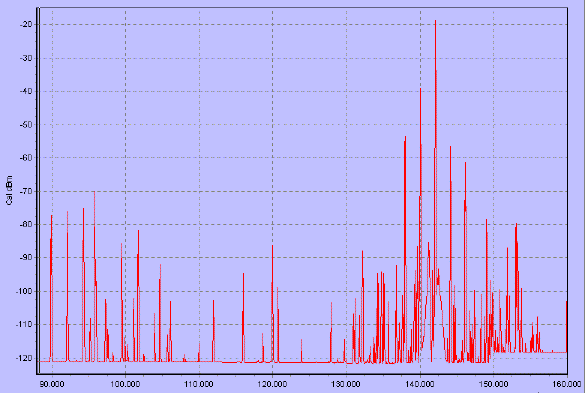
Note that signals beyond the passband of the preamp's output filter are now much attenuated, however the big carrier at 142MHz is now amplified to even greater levels.
My Receive Converter plus IF that normally follows the Mutek preamp has an input IP3 of -5dBm and can therefore only handle signals up to around the -50dBm level without intermod being detectable. Clearly some of the signals are getting getting close to that and one at 142MHz is way above it.
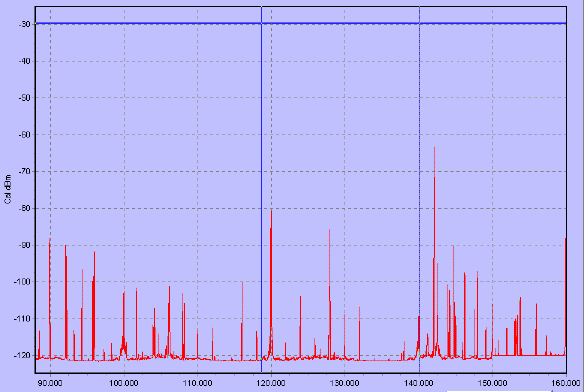
The final scan is with the Mutek Preamp followed by a 4 pole Helical Filter.
This filter has about 3dB Insertion loss at 144MHz but has a lot of attenuation at 142MHz. As you can see the 142MHz carrier is now reduced to below -60dBm and so should not worry the rest of the receiving chain.
Copyright © David Anderson GM4JJJ January 2000